
Monthly SDUP report to Sodra from 2027: what to prepare with your accountant
Updated 2026-10-22
From 1 January 2027 every employer reports to Sodra each month on employees’ pay, working time and job group under the pay system. The tool is a new report, form SDUP. The first report is due by 28 February 2027, for January 2027. Your accountant will file it, but the job groups, working-time data and list of benefits must come from you. This article covers what to hand over, by when, and how to check that the data matches your approved pay system. What else an employer must do by 31 December 2026 is summarised on atlygis.linden.lt: preparing for the pay transparency directive. For an overview of all the duties, see “Pay transparency in Lithuania: what employers must do, and by when”.
Implementation deadlines
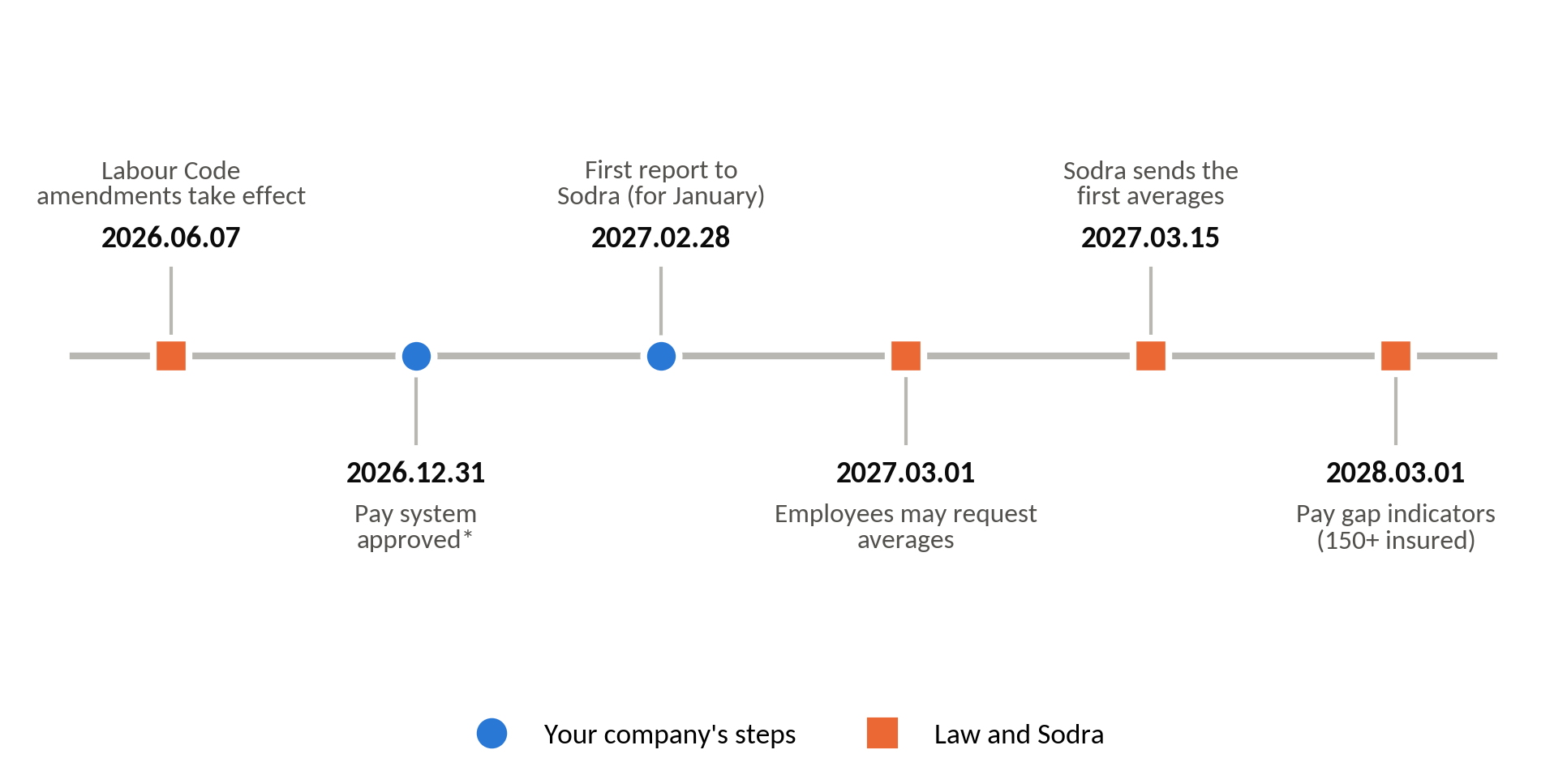
* Before approving the system, the employer must inform and consult the employee representatives. If the company has a works council, it must be informed at least 10 working days before the planned approval.
What the rules say
The law: employers must report to Sodra every month on employees’ pay, working time and the job group set in the pay system (DK Article 23(3), edition from 1 January 2027). How to evaluate positions and sort them into groups is explained in “Job evaluation and grouping for a pay system: a practical guide”. Exceptions: officers, statutory civil servants, persons whose data are a state or service secret, and temporary agency workers whose pay indicators are submitted under DK Article 23(8) (DK Article 23(3), edition from 1 January 2027). The Order exempts professional military servicemen and all temporary agency workers (Order A1-433, Description point 9). Data on temporary agency workers is reported by the agency, not the user company (VDI FAQ, question 4.5). Sodra’s SDUP rules, approved by the Sodra Director’s Order No. V-500 of 5 October 2026 (the V-500 rules), add that the report also covers employees not under Lithuanian social insurance law and employees for whom 9-SD, 12-SD or NP-SD2 reports were filed (V-500 rules, point 6).
V-500 rules point 6.2, like Description point 9, leaves workers on temporary-agency contracts out of SDUP whatever the agency’s size. The DK Article 23(3) exception is narrower (it covers workers whose indicators are filed under paragraph 8), but under Sodra’s rules these workers are not reported in SDUP. Agencies with 100 or more insured persons calculate these workers’ indicators themselves and file them with Sodra (DK Article 23(8), edition from 1 January 2027).
The details are set by Order No. A1-433 of the Minister of Social Security and Labour of 17 July 2026:
- When: every month, by the last day of the month, for the previous month, through Sodra’s EDAS system (Description point 6).
- First time: by 28 February 2027, for 1–31 January 2027 (Order point 2.1).
- Every month: gross monthly pay, gross additional monthly pay, and paid working time in hours (Description point 6).
- First report only, in addition: the employee’s working-time norm, working-time regime and job group number under the pay system (Description point 7).
- Afterwards: in EDAS, these three items are updated only when they change (Description point 8). A report sent from payroll software must include them every time (V-500 rules, point 20).
The duty applies to every employer, whatever its size. Headcount matters in two cases. First, if you have at least 8 employees (more than 3 women and more than 3 men), Sodra will publish your company’s average pay per hour for men and for women every month (DK Article 23(6), edition from 1 January 2027; Order A1-433, Description point 16). Second, the gender pay gap indicators: Sodra calculates them for employers with 100 or more insured persons, and for smaller employers that opt in (DK Article 23(4), edition from 1 January 2027). First time: by 1 March 2028 (150 or more) or by 1 March 2031 (100–149) (Article 23(5) of the Law amending the Labour Code). After that, Sodra provides these indicators every year to employers with 250 or more insured persons, and every three years to those with 100 to 249 and to smaller employers that opt in (DK Article 23(4) and (5), edition from 1 January 2027; Description point 13). A smaller employer opts in by ticking the relevant box in EDAS (Sodra’s SDUP rules, point 7). In addition, Sodra provides employers every month, by the 15th, with each employee’s monthly average hourly pay and the averages for men and for women in each job group, and the annual figures every year; the Order sets no size condition here (Description points 10 and 11). These are the figures the employer gives an employee who asks (DK Article 148(5), edition from 1 January 2027). DK Article 23(5) links these figures to the employers referred to in paragraph 4, so the law is not clear on whether an employer with fewer than 100 insured persons receives them without ticking the consent box (see our article on employee requests).
The rules for filling in form SDUP are set by the Director of Sodra (Description point 3.1). They have now been approved: Order No. V-500 of the Director of Sodra of 5 October 2026, in force since 7 October 2026. The annex to the rules is the list of the fields of form SDUP (the form, DOCX from e-TAR, in Lithuanian). The main points for your accountant:
- The report may be filed, corrected and viewed by the employer or a person it has authorised (Sodra’s SDUP rules, point 12). An outside accounting firm can file it if you authorise it.
- When the form is filled in EDAS, the job group, working-time norm and regime (fields D1–D3) are filled in automatically from earlier data and changed only when they change. When the report is sent from payroll software, these items must be in every report (point 20).
- If you choose to fill the form with Sodra’s data, the insured income from your SAM and/or 2-SD reports is loaded into it. The employer must check that it equals gross accrued pay and, if not, enter the correct amount. Additional pay (D5) and paid hours (D6) are always typed in by the person filling in the form (point 14).
- If an employee holds jobs in different groups, or the group changes during the month, each group goes on a separate line (point 19).
- When an error is found, a corrected report is filed at once and no later than within 2 working days of finding the error, with correct data for all employees for that period (points 24 and 27).
- On its own initiative the employer corrects data for the current year. After a correction, Sodra recalculates the monthly figures on the 5th of each month, until 5 February of the following year at the latest (points 25.1 and 26).
- A leaver’s data go in the report for the month in which employment ended (point 21).
- Sodra explains what counts: pay for annual leave, for extra rest days for parents and for downtime not caused by the employee is included. Sickness benefit (also when the employer pays it), material aid, compensation for unused leave, severance pay and other compensation payments are left out, as is income on which no social and health insurance contributions are paid. Sick time paid by sickness benefit is not counted in paid hours (Sodra Q&A, 13 October 2026).
- The report can be filled in EDAS, uploaded to EDAS as a JSON file, or sent automatically system-to-system (point 22).
Sources, in Lithuanian: Sodra Director’s Order No. V-500 with the rules and the list of form fields (e-TAR); Sodra’s SDUP data structure description (PDF) and SDUP JSON schema for payroll software developers. Read the rules together with your accountant.
Five items only the employer can provide
Your accountant knows salaries and hours. Field D6 is all paid hours: hours worked and paid non-working time, such as annual leave (V-500 rules, point 18; Description point 4.6). These items the accountant cannot work out alone:
- Job group number for each employee. The group is expressed by the number given in your pay system (Description point 4.3). VDI says the number may contain digits, letters, a dot and a dash, and recommends asking Sodra about the field format (VDI FAQ, question 4.6). Sodra’s rules narrow this: letters must be Latin, without diacritics such as ą, č or ė; digits, a dot and a dash are also allowed (Sodra’s SDUP rules, point 19).
- Two jobs, one line per group. In the report, each of the employee’s job groups goes on a separate line (V-500 rules, point 19).
- Working-time norm: the average weekly hours under the employment contract. A norm set for another period is converted to an average weekly norm (Description point 4.1; VDI FAQ, question 4.7).
- Working-time regime: one of five: fixed working day, aggregated working time, flexible schedule, split working day, or individual regime (Description point 4.2).
- Benefits in kind. Gross pay includes pay in money and in kind (Description point 4.4). Additional pay in kind may be left out when all employees of the same job group, without any exception, receive the same benefit, such as a meal voucher or a Christmas gift card, with no possibility of different terms (Description point 4.4; see also VDI FAQ, question 5.1). Daily travel allowances that only compensate expenses are left out (VDI FAQ, question 4.2). Compensation for on-call time at home is included (VDI FAQ, question 4.4). Income on which no state social insurance and compulsory health insurance contributions are paid is left out (Description points 4.4 and 4.5). Check each benefit’s contribution status with your accountant.
What Sodra sends back
From your data Sodra will calculate, every month, each employee’s average pay per hour and the average pay per hour of men and of women in each of your job groups (Description point 10). First by 15 March 2027, then by the 15th of each month for the month before last (Order point 3.1.3). Employees can ask for these figures from 1 March 2027. A wrong group in the SDUP report therefore means a wrong answer to an employee.
Handover table for the accountant
| What the employer hands over | By | Who |
|---|---|---|
| Approved pay system with group numbers | 2026-12-31 | Manager |
| List: employee – job – group number | 2027-01-15 | Manager or HR person |
| Working-time norm and regime per employee | 2027-01-15 | HR person |
| List of benefits in kind, marked whether equal for the whole group | 2027-01-15 | Manager |
| Employees with two jobs and their groups | 2027-01-15 | HR person |
| Test check: group numbers match the system | 2027-02-19 | Manager and accountant |
| First SDUP filed in EDAS | 2027-02-26 (deadline 2027-02-28) | Accountant |
| Changes (new job, group, norm) | Same month as the change | Manager tells the accountant |
Our recommendation: we chose 15 January 2027 so the accountant has time to set up the payroll software. The law does not set that date. The only legal deadline is 28 February 2027. That is a Sunday, so we recommend filing by Friday, 26 February 2027.
Worked example: a 12-person and a 45-person company
A 12-person services company, 4 groups. Group 1: cleaner. Group 2: two customer service specialists and a storekeeper. Group 3: five project managers and an accountant. Group 4: the managing director and the sales manager. Everyone works 40 hours a week on a fixed working day. Only the managing director gets extra health insurance; the sales manager in the same group does not. The benefit is not equal for the whole group, so, if social and health insurance contributions are paid on it, its value is included in the director’s pay. The accountant checks the contribution status. Meal vouchers are equal for everyone, so they may be left out.
A 45-person manufacturer, 6 groups. Production uses aggregated working time; the office works a fixed day. Six employees work part time, 20 or 30 hours a week, and their norm is stated exactly. One employee is both warehouse head (group 4) and, under a separate agreement, occupational safety specialist (group 3). In the report each of his job groups goes on a separate line, each with its own group, pay and hours (V-500 rules, point 19). Group 5 has two sub-levels, 5.1 and 5.2. If you report the sub-levels, Sodra will calculate averages only within each sub-level (VDI FAQ, question 2.8). Decide this in advance and write it into the system.
Email to the accountant (copy it)
Hello,
from January 2027 we must file form SDUP with Sodra every month (Order No. A1-433 of 17 July 2026). The first report, for January 2027, is due by 28 February 2027.
Attached: (1) the approved pay system; (2) a table “employee – job – group number”; (3) each employee’s working-time norm and regime; (4) a list of benefits in kind, marked whether equal for the whole group; (5) employees who hold two jobs.
Please: check that the payroll software can record a group number and, for one employee, several lines with different group numbers; send us a draft report by 19 February 2027; read Sodra’s SDUP filling rules (Sodra Director’s Order No. V-500 of 5 October 2026) and tell us if you need any other data from us.
We will tell you about any change of job, group or working time in the same month.
Checklist before the first report
- Every employee has a group, and the group is in the approved system.
- Group numbers in the SDUP report are written exactly as in the system.
- For an employee with two jobs, each job group goes on a separate line.
- Part-timers’ norms match their employment contracts.
- Benefits in kind are valued in money, or marked as equal for the whole group.
- Temporary agency workers and other excluded persons are left out (V-500 rules, points 6.1–6.2).
- You know who tells the accountant about changes.
Mistakes to avoid
- Group numbers do not match the system. The system says “Group III”, the software says “3”. Use one label everywhere.
- Group changed, Sodra not told. An employee is promoted but the SDUP report keeps the old group. Sodra’s averages and the answers to employees will then be wrong.
- Benefits in kind forgotten. A car for private use, insurance or a gym membership for only some employees is pay (VDI FAQ, question 5.1). You leave it out of the Sodra data only where no social and health insurance contributions are due on it (Description points 4.4 and 4.5).
- System rewritten, numbering changed. Our recommendation: do not change group numbers. Each group keeps its number, a new group gets a new number, and a removed group’s number is never given to another group. For Sodra, a group is expressed by its number (Description point 4.3). If you renumber mid-year, Sodra’s annual figures may mix two different groups.
What to do if…
…the pay system is not approved by 31 December 2026. There will be no group numbers to report, but the report is still due. The system had to be approved by 31 December 2026 (Article 23(4) of the Law amending the Labour Code). Approve it as soon as you can, after the information and consultation procedure (DK Article 140(3)). By mid-January 2027 at the latest, have a draft with final group numbers.
…an employee changes job mid-month. The job group is one of the items updated when it changes (Description point 8). If the group changes during the month, that month’s report gives each group on a separate line (Sodra’s SDUP rules, point 19). Record the date of the change and pass it to the accountant the same day.
…your accountant is an outside firm. If its contract predates this duty, SDUP filing may not be covered. Agree in writing who files SDUP, when you hand over the data, and who is responsible if data is missing. Towards Sodra, the employer remains responsible.
…the report is not filed. From 1 January 2027, failing to give Sodra the pay information required by the Labour Code carries a fine for employers or other responsible persons of four hundred and sixty to seven hundred euros, and for a repeat breach seven hundred to one thousand four hundred euros (ANK Article 99(1) and (2), edition from 1 January 2027).
Frequently asked questions
When is the first SDUP report due?
By 28 February 2027, for January 2027 (Order No. A1-433, point 2.1). After that, every month by the last day of the month for the previous month, through Sodra’s EDAS (Description point 6). 28 February 2027 is a Sunday. Our recommendation: file the notice by 26 February.
Is the SDUP report mandatory for a small company?
Yes. The duty to report applies to all employers, whatever their size (DK Article 23(3), edition from 2027-01-01).
What must be reported the first time?
Every month: gross monthly pay, gross additional pay and paid hours (Description point 6). The first time, also the working-time norm, the working-time regime and the position group number under the pay system (Description point 7). Later, in EDAS, these three items are updated only when they change (Description point 8). A report sent from payroll software must include them every time (V-500 rules, point 20).
What if an employee holds two positions?
If an employee holds several positions in different groups, the data are reported separately for each (Description point 7).
Do meal vouchers and other benefits count?
Additional pay in kind may be left out where all employees in the same group get the same benefit without exception (Description point 4.4). Per diems that compensate expenses are not included (VDI FAQ, question 4.2).
What fine applies if the report is not filed?
From 1 January 2027, failing to give Sodra the pay information carries a fine of EUR 460 to 700, and EUR 700 to 1400 for a repeat (ANK Article 99(1) and (2), edition from 2027-01-01).
Related articles
- Employee requests for pay data from 1 March 2027: how to reply
- Small employers: a minimum pay system by 31 December 2026
- Job evaluation and grouping for a pay system: a practical guide
- Bonuses and variable pay in a Lithuanian pay system: how to write them
- Pay transparency in Lithuania: what employers must do, and by when
How to start
Send us your pay system (or its draft) and your list of jobs. We will check whether the groups and their numbers work for the SDUP report, and prepare the table and the letter for your accountant.
Linden’s full solution, from the pay system to informing employees, is at atlygis.linden.lt. Check which requirements apply to you: atlygis.linden.lt/en/self-check.
Phone +370 5 212 1506, email info@linden.lt
More about this service: drafting labour law documents.


