
Pay transparency in Lithuania: what employers must do, and by when
Updated 2026-10-12
Lithuania transposed Pay Transparency Directive (EU) 2023/970 by Law No. XV-969 of 21 May 2026 amending the Labour Code (Article 22 of the Law amending the Labour Code). Most of the changes apply from 7 June 2026, the rules on pay data reporting apply from 1 January 2027, and the first gap indicators come in 2028 or 2031, depending on the number of insured persons. The first task is the same for every employer: by 31 December 2026, adopt a pay system, or review the one you have. Then come the recruitment and confidentiality rules, the employees’ right to pay data, and reports whose scope depends on your headcount. Below is the whole procedure in order, with dates.
How to set a new hire’s pay when they negotiate a higher salary, we have already answered in the FAQ of our labour law consultations page (in Lithuanian). This article covers what the company must do as a system.
Deadlines and fines in one table
| What | By when | Fine or consequence | Source |
|---|---|---|---|
| Approve or review the pay system, after the informing and consultation procedures | 2026-12-31 | In our view, a missing system may be treated as a breach of the pay-setting rules: a fine of EUR 500–1450, EUR 1450–3000 for a repeat, EUR 2700–6000 if intentional. Another reading is a breach of labour laws: EUR 240–880 | Law amending the Labour Code, Article 23(4); DK Article 140(3); ANK Article 99(3)–(5), edition from 2027-01-01; ANK Article 96(2) |
| First monthly SDUP report to Sodra for January 2027, then every month by the last day of the month | 2027-02-28 | Failing to give Sodra the information: a fine of EUR 460–700, EUR 700–1400 for a repeat | DK Article 23(3), edition from 2027-01-01; Order No. A1-433, point 2.1; ANK Article 99(1) and (2), edition from 2027-01-01 |
| Reply in writing to an employee request for pay data (requests from 2027-03-01) | Within 1 month of receiving the request; explanations no later than 2 months from receiving the original request | Failing to give an employee the information: a fine of EUR 460–700, EUR 700–1400 for a repeat | DK Article 148(5), edition from 2027-01-01; Order No. A1-433, point 2.3; ANK Article 99(1) and (2), edition from 2027-01-01 |
| Give the data to VDI or the Equal Opportunities Ombudsperson when they ask | Within the period they set, no later than 10 working days | Failing to give the information: a fine of EUR 460–700, EUR 700–1400 for a repeat | DK Article 148(6), edition from 2027-01-01; ANK Article 99(1) and (2), edition from 2027-01-01 |
| Correct an unjustified pay difference (employers with 100 or more insured persons) | Within 6 months of receiving the indicators; first indicators by 2028-03-01 (150 or more) or by 2031-03-01 (100–149) | If the average pay gap between women and men in any position group is at least 5 %, unjustified and not corrected within 6 months, a joint pay assessment with employee representatives is mandatory | DK Article 23(10) and (11), edition from 2027-01-01; Law amending the Labour Code, Article 23(5) |
| Pay equally for the same work or work of equal value | Always | The employee is awarded compensation: unpaid pay, pecuniary and non-pecuniary damage, lost opportunities. Once the employee points to facts from which discrimination may be presumed, the employer must prove there was none | DK Article 219(2); DK Article 26(5) |
ANK Article 99 fines are imposed on employers or other responsible persons; the ANK Article 96(2) fine on employers who are natural persons, heads of legal-entity employers or other responsible persons. More in “Fines and disputes: the risk of having no pay system in Lithuania”.
What applies from when
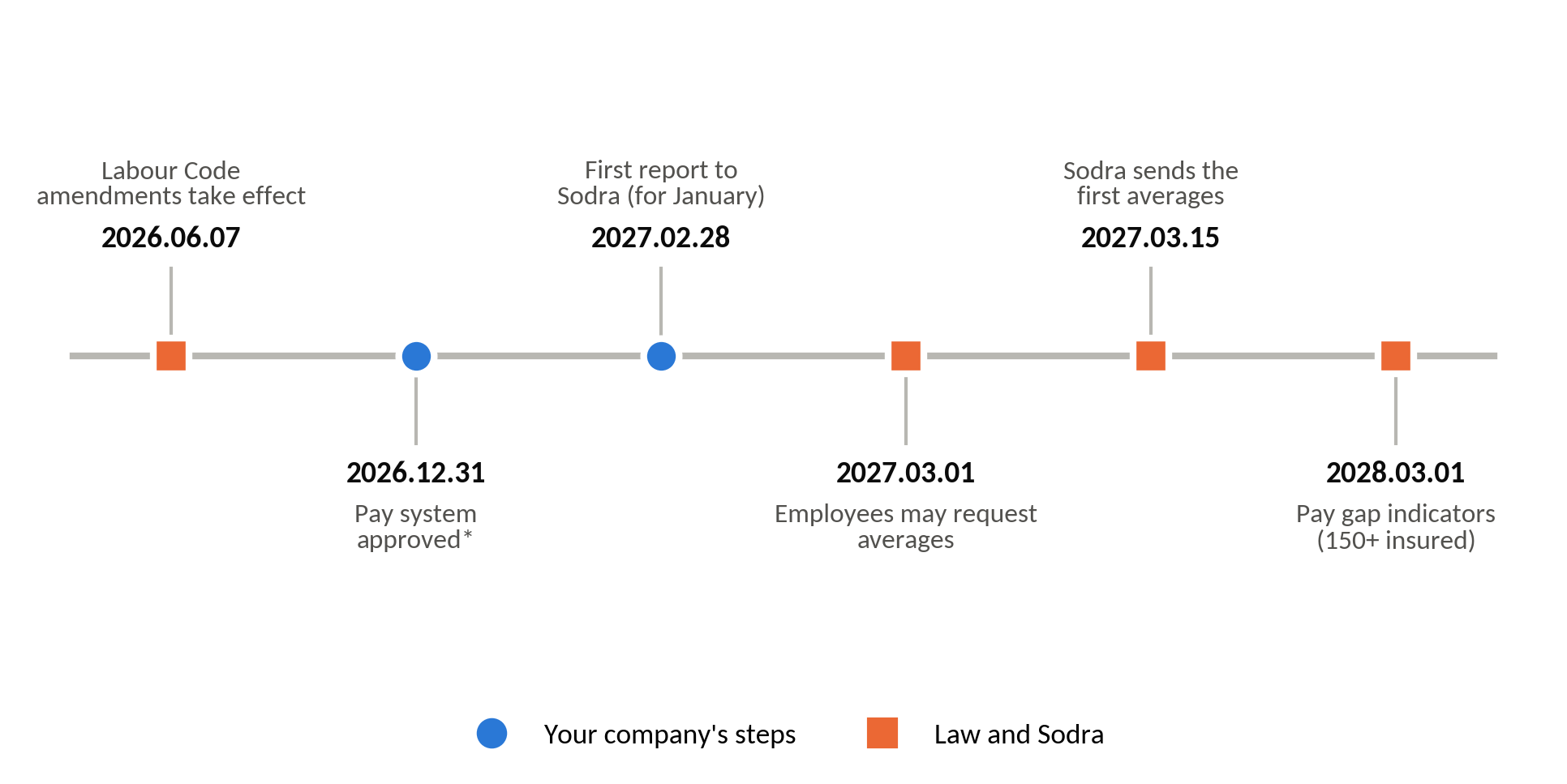
* Before approving the system, the employer must inform and consult the employee representatives. If the company has a works council, it must be informed at least 10 working days before the planned approval.
Law No. XV-969, except its Article 2 and Article 17 and Article 23(2) and (3), enters into force on 7 June 2026 (Article 23(1) of the Law amending the Labour Code). Its Article 2 and Article 17, which amend Article 23 and Article 148 of the Labour Code, enter into force on 1 January 2027 (Article 23(2) of the Law amending the Labour Code).
In practice there are four stages:
- from 7 June 2026: new requirements for the pay system, recruitment and confidentiality;
- by 31 December 2026: adopting or reviewing the pay system;
- from 1 January 2027: monthly data to the state and the employee’s right to the indicators for themselves and their group of positions (DK Article 148(4), DK as in force from 1 January 2027). Employers provide them only once the State Social Insurance Fund Board (Valstybinio socialinio draudimo fondo valdyba, Sodra; the Board) has supplied them, and the Board first supplies the annual figures by 1 March 2028 (Article 23(8) and (9) of the Law amending the Labour Code). Order No. A1-433 of the Minister of Social Security and Labour of 17 July 2026 (in force from 31 July 2026) sets the first dates: employers file the first monthly report, for January 2027, with the Board by 28 February 2027; employees may ask for the monthly data (their own monthly average pay per hour, and the monthly average pay per hour by sex in their group of positions) from 1 March 2027, and for the annual data from 1 March 2028; and the Board first supplies the monthly figures to employers by 15 March 2027 (points 2.1, 2.3 and 3.1.3 of Order No. A1-433);
- 2028 or 2031: gap indicators, first by 1 March 2028 or by 1 March 2031, depending on the number of insured persons (Article 23(5) of the Law amending the Labour Code).
Step 1: a pay system by 31 December 2026
By 31 December 2026 employers adopt a pay system (darbo apmokėjimo sistema). Where a system already exists, they review it and amend it if needed, following Article 140 of the Labour Code (Article 23(4) of the Law amending the Labour Code).
What the system must contain is set by Article 140(3) of the Labour Code of the Republic of Lithuania (DK):
- if no collective agreement sets the pay system, the employer adopts it and makes it available to all employees;
- before a system is adopted or changed, the information and consultation procedures must be carried out;
- positions are grouped by objective, gender-neutral criteria: skills, qualifications, effort, responsibility, working conditions and, where appropriate, other relevant criteria;
- positions to which the same work or work of equal value is assigned go into the same group;
- the system sets the forms of pay, pay levels or ranges (minimum and maximum), the grounds, amounts and procedure for supplements, allowances and bonuses, and the criteria and procedure for indexing and raising pay.
One exception. Employers with fewer than 50 employees are exempt from the duty to set out criteria and a procedure for pay rises in the system (DK Article 140(3)). The exception does not remove the other requirements.
The system must be designed so that discrimination on grounds of sex and other grounds is avoided. The same work is work where the two employees could swap places without the employer incurring higher expenses. Work of equal value is assessed by the same criteria of Article 140(3) (DK Article 140(5)).
The most important part of the system is not the text of the document but the grouping of the positions. Start with a list of positions and, for each one, write down the skills, effort, responsibility and conditions it requires.
Step 2: recruitment and the job offer
In a job advertisement the employer must state the offered base pay and/or its range, except in cases provided for by law (DK Article 25(6)).
DK Article 41(1) prohibits requiring a candidate to give information about pay in current or previous employment, and Article 5(2) of Directive (EU) 2023/970 says an employer shall not ask applicants about their pay history. So the question “how much do you earn now?” has to be removed from forms, interview scripts and briefs to recruitment agencies.
Where the company has a collective agreement in force, the future employer must, before the contract is signed, provide not only the job-advertisement information but also the provisions of the collective agreement that will apply. The information is provided so as to ensure well-founded and transparent pay negotiations (DK Article 41(1)).
Step 3: confidentiality agreements and work rules
Data about one’s own pay cannot be treated as confidential information where the employee discloses it in order to enforce the right to equal pay for the same work or work of equal value (DK Article 39(1)).
Review employment contracts, confidentiality agreements and work rules. The wording “salary is confidential information” is now too broad. It will not create a prohibition where the law does not allow one. It is safer to define precisely what is confidential in the company, for example by a list of confidential information approved by the manager and made known to employees.
Step 4: the employees’ right to pay data from 1 January 2027
From 1 January 2027 an employee has the right to receive from the employer, in writing, data on their own annual pay and their average pay per hour (for the month and for the year). They are also entitled to the employer’s average annual pay and average pay per hour (for the month and for the year), broken down by sex, for the group of positions to which their own position belongs. Employers must inform employees every year of this right and of how the data are provided (DK Article 148(4), DK as in force from 1 January 2027).
At the employee’s request, the employer provides these data, received from the State Social Insurance Fund Board (Valstybinio socialinio draudimo fondo valdyba), in writing within one month of receiving the request. If the data are inaccurate or incomplete, the employee may ask for explanations, and providing them may not take longer than 2 months from receipt of the employee’s original request for the data (DK Article 148(5), DK as in force from 1 January 2027). If the State Labour Inspectorate (Valstybinė darbo inspekcija) or the Office of the Equal Opportunities Ombudsperson (Lygių galimybių kontrolieriaus tarnyba) asks for the data, they must be provided within the time it sets, but no later than 10 working days from receipt of the request (DK Article 148(6), DK as in force from 1 January 2027).
The Board calculates each employee’s figures and the averages of all the employer’s employees by sex in the same group of positions from the data employers submit every month (DK Article 23(3) and (4), DK as in force from 1 January 2027). In DK Article 23(4) the headcount bands (100 to 249, and 250 or more insured persons) are attached to the previous calendar year’s gap indicators; that paragraph also mentions employers with fewer insured persons who wish the same data-processing rules to apply to them as to employers with 100 to 249 insured persons. For each employee’s figures and the group figures, that paragraph sets no such bands. The Board supplies these figures “to the employers referred to in paragraph 4 of this Article” (DK Article 23(5), DK as in force from 1 January 2027), and first supplies the annual figures to employers by 1 March 2028 (Article 23(8) of the Law amending the Labour Code). DK Article 148(4) does not limit by employer size either the employee’s right to these data or the duty to inform employees every year of that right. The text of the Code does not say clearly whether the Board will also supply these figures to employers with fewer than 100 insured persons. The Minister approved the procedure for these data by Order No. A1-433 of 17 July 2026 (DK Article 23(12), DK as in force from 1 January 2027). Point 10 of the Description it approves says that every month the Board calculates the monthly figures and supplies them to employers (apskaičiuoja ir darbdaviams pateikia), and under point 6 the monthly data are filed with the Board by employers. Neither point sets a headcount threshold. The thresholds (100 to 249, and 250 or more insured persons) in points 13 and 17 apply to the annual gap indicators and their publication. So prepare to provide these data whatever your headcount. Under the Order, from 1 March 2027 employees may ask for their own monthly average pay per hour and the monthly average pay per hour by sex in their group of positions, and the first data, provided in March 2027, cover January 2027. The right to the annual data starts on 1 March 2028 (point 2.3 of Order No. A1-433).
If the data would reveal the pay of another identifiable employee, they are, at the employee’s request, provided only to the employees’ representatives, the State Labour Inspectorate or the Office of the Equal Opportunities Ombudsperson (DK Article 148(7), DK as in force from 1 January 2027). The employer may require that the employee use the data received, other than data about their own pay, only to enforce the right to equal pay. Breach of this requirement may be treated as a breach of work duties (DK Article 148(8), DK as in force from 1 January 2027).
An important transitional rule: employers start providing these indicators only after the State Social Insurance Fund Board has provided them (Article 23(9) of the Law amending the Labour Code). The Board first provides employers with each employee’s annual figures and the employer’s annual figures by group of positions and sex by 1 March 2028 (Article 23(8) of the Law amending the Labour Code). The Board first supplies the monthly figures to employers by 15 March 2027 (point 3.1.3 of Order No. A1-433). The duty to inform employees every year of their right is a separate one, so it is worth putting it into the work rules now.
Step 5: reports by headcount
Already today, an employer whose average number of employees is more than twenty must, at the request of the works council (or, if there is none, the trade union acting at employer level), provide information updated at least once a year. This is anonymised data on average pay by group of positions and sex, excluding management positions, where a group has more than 2 employees (DK Article 23(2)).
From 1 January 2027 employers submit monthly data to the State Social Insurance Fund Board on employees’ pay, working time and group of positions under the pay system. The exception is data on officers, statutory civil servants, persons whose data are state or official secrets, and temporary agency workers whose pay indicators are submitted under DK Article 23(8): these are not submitted to the Board in this way (DK Article 23(3), DK as in force from 1 January 2027). So the groups of positions in the system need to be clear by that date. The first monthly report (form SDUP), for January 2027, is filed through Sodra’s electronic system for insurers (EDAS) by 28 February 2027; after that, every month by the last day of the month for the previous month (point 2.1 of Order No. A1-433; point 6 of the Description). The first report also gives each employee’s working time norm, working time regime and group-of-positions number under the pay system (point 7 of the Description). The Board first supplies the monthly figures to employers by 15 March 2027 (point 3.1.3 of Order No. A1-433).
From these data the Board itself calculates the gender pay gap indicators. For employers with 100 to 249 insured persons this is done every three years, and for those with 250 or more every year (DK Article 23(4), DK as in force from 1 January 2027). Smaller employers may opt for the same rules to apply to them (DK Article 23(4), DK as in force from 1 January 2027).
After receiving the indicators, the employer must, within one month, give the employees’ representatives and employees the indicator of the gap in base and supplementary pay by group of positions, where a group has more than 2 employees of either sex (DK Article 23(5), DK as in force from 1 January 2027).
The first deadlines are set in the transitional provisions (Article 23(5) of the Law amending the Labour Code):
- for employers with 150 or more insured persons, the Board first provides the indicators by 1 March 2028;
- for employers with 100 to 149 insured persons (and smaller employers that opted in), by 1 March 2031.
These employers’ indicators are first published by 1 April 2028 and by 1 April 2031 respectively (Article 23(7) of the Law amending the Labour Code). In addition, every month the Board publishes the average pay per hour of men and women for employers with at least 8 employees (more than 3 women and more than 3 men) (DK Article 23(6), DK as in force from 1 January 2027).
If you are a temporary work agency: with 100 to 249 insured persons you calculate the indicators for temporary workers yourself and submit them to the Board every three years, and with 250 or more every year. You also give the indicator in point 7 of DK Article 23(4) to employees’ representatives and employees, where a group of positions has more than 2 employees of either sex (DK Article 23(8), DK as in force from 1 January 2027). The first submission is due by 1 March 2028 (150 or more insured persons) or by 1 March 2031 (100 to 149) (Article 23(6) of the Law amending the Labour Code). For a user undertaking, note that temporary workers may also ask it for the indicators and explanations (DK Article 148(5), DK as in force from 1 January 2027).
Step 6: explanations, correction and joint pay assessment
These duties do not apply to every employer. They apply only to the employers referred to in DK Article 23(7) and (8), that is, those with 100 to 249 or with 250 or more insured persons (DK Article 23(7) and (8), DK as in force from 1 January 2027).
If, after the indicators are provided, employees or their representatives have questions, the employer must give explanations at their request within a reasonable time, but no later than one month from receipt of the request for explanations. If the State Labour Inspectorate or the Office of the Equal Opportunities Ombudsperson asks, within the time they set, but no later than 10 working days (DK Article 23(9), DK as in force from 1 January 2027).
If a difference is not justified by objective, gender-neutral criteria, the employer corrects it within a reasonable time, but no later than six months from receiving the indicators (for temporary workers, from the day the indicators are submitted to the Board), in cooperation with the employees’ representatives (DK Article 23(10), DK as in force from 1 January 2027).
A joint pay assessment is mandatory when all three conditions are met (DK Article 23(11), DK as in force from 1 January 2027):
- the indicators show a difference of at least 5 per cent in average pay between women and men in any group of positions;
- the employer has not justified the difference by objective, gender-neutral criteria;
- the employer has not corrected the unjustified difference within six months of receiving the indicators (for temporary workers, from the day the indicators are submitted to the Board).
The employer carries out the assessment in cooperation with the employees’ representatives and provides it to employees, their representatives and the State Labour Inspectorate (DK Article 23(11), DK as in force from 1 January 2027). The procedure for data collection and the joint assessment is set by the Minister of Social Security and Labour (DK Article 23(12), DK as in force from 1 January 2027). The Minister set it by Order No. A1-433: a commission of employer and employee representatives is set up for the assessment, with at least three members, including at least one employee representative. If there are no employee representatives, other employees with knowledge or skills relevant to pay assessment may sit on it (point 21 of the Description). The procedure must be started within 10 working days of the circumstances referred to in DK Article 23(11) being established, the assessment may not last longer than 4 months from the commission’s formation, and the measures set in the protocol must be implemented within 6 months of its drawing up (points 20 and 26 of the Description).
Who does what
The law puts these duties on the employer. How to share them out inside the company is our recommendation. In a small company one person may hold several of these roles.
| Who | 1. Pay system by 2026-12-31 | 2. Recruitment | 3. Confidentiality | 4. Data for employees | 5. Sodra and reports |
|---|---|---|---|---|---|
| Manager | Approves the system by order once informing and consultation are done | Approves the pay ranges used in job ads | Approves the list of confidential information | Names who answers requests, and a deputy | Approves the position group numbers |
| HR | List of positions, job descriptions, evaluation and grouping | States the base pay or its range in the ad; does not ask candidates for their current or past pay | Makes employees familiar with the list of confidential information | Tells employees every year about their right; replies within 1 month | Gives the accountant each employee’s group, working-time norm and regime |
| Accountant | Provides current pay, allowances and benefits | – | – | Passes on the figures supplied by Sodra | Files the SDUP report every month, the first by 2027-02-28 |
| Lawyer | Drafts the system and the informing and consultation documents | Checks forms, interview scripts and briefs to recruitment agencies | Amends employment contracts, confidentiality agreements and work rules | Checks small groups so that a reply does not disclose a colleague’s pay | Helps prepare explanations of gap indicators (100 or more insured persons) |
| Employee representatives | The works council or trustee is informed and consulted before approval; if there is none, the trade union is informed and may give its opinion | – | – | At the employee’s request, receive data that would disclose an identifiable colleague’s pay | The works council (if none, the employer-level trade union) may demand yearly depersonalised average pay data by group and sex (on average more than 20 employees; excluding managers; only for groups with more than 2 employees); together with the employees, within 1 month receive the gap indicator for position groups with more than 2 employees of either sex (100 or more insured persons) |
Basis: DK Article 140(3); DK Article 25(6); DK Article 41(1); DK Article 39(1); DK Article 148(4), (5) and (7), edition from 2027-01-01; DK Article 23(2); DK Article 23(3) and (5), edition from 2027-01-01; Order No. A1-433, point 2.1.
What is at stake if a dispute arises
Once the employee points to circumstances from which it may be presumed that they were discriminated against, the burden is on the employer to prove that there was no discrimination (DK Article 26(5)). In pay discrimination cases, the comparison is not limited to employees hired at the same time (DK Article 26(4)(4)).
If a breach is found, the employee is awarded compensation. It covers full recovery of unpaid pay, compensation for pecuniary and non-pecuniary damage, and compensation for lost job-related opportunities (DK Article 219(2)). In such cases the court may depart from the usual rules on allocating litigation expenses, taking into account whether the parties’ conduct in the proceedings was proper (DK Article 217(4)).
So the best protection is paperwork: an adopted system, clear grouping criteria and written reasons why a particular employee’s pay is set as it is.
Frequently asked questions
Is a pay system mandatory for a small company?
Yes. The first task is the same for every employer: approve a pay system by 31 December 2026 or review the existing one (the Law amending the Labour Code, Article 23(4)). Only an employer whose pay system is set by a collective agreement does not approve one separately (DK Article 140(3)). In our view, that employer must still review the existing system by 31 December 2026 (the Law amending the Labour Code, Article 23(4)).
What changes from 2027?
From 1 January 2027 employers report monthly to Sodra on employees’ pay, working time and position group. The first report, for January 2027, is due by 28 February 2027. Employees may ask for the monthly data from 1 March 2027 and for the annual data from 1 March 2028 (DK Article 23(3), edition from 2027-01-01; Order No. A1-433, points 2.1 and 2.3).
What if only 2 or 3 people work in a position group?
If the data would disclose the pay of another identifiable employee, they are given, at the employee’s request, only to employee representatives, the State Labour Inspectorate or the Equal Opportunities Ombudsperson (DK Article 148(7), edition from 2027-01-01). An employer that receives gap indicators (100 or more insured persons) gives employees the indicator by position group only for groups with more than 2 employees of one sex (DK Article 23(5), edition from 2027-01-01).
Do the gap indicators apply to my company?
Sodra calculates them for employers with 100 to 249 insured persons (every three years) and with 250 or more (every year). Smaller employers may choose to have the same rules applied (DK Article 23(4), edition from 2027-01-01). The first indicators come by 1 March 2028 (150 or more insured persons) or by 1 March 2031 (100 to 149, and smaller employers that opted in) (the Law amending the Labour Code, Article 23(5)).
Can an employment contract say that pay is confidential information?
That wording is now too broad. Data on an employee’s own pay cannot be treated as confidential where the employee discloses them to enforce the right to equal pay for the same work or work of equal value (DK Article 39(1)).
Can we ask a candidate how much they earn now?
No. DK Article 41(1) prohibits requiring a candidate to give information about pay in current or previous employment, and Article 5(2) of Directive (EU) 2023/970 says an employer shall not ask applicants about their pay history. A job advertisement must state the offered base pay and/or its range, except in cases provided for by law (DK Article 25(6)).
More on pay transparency
- Hiring and job ads in Lithuania: pay ranges, interviews, confidentiality
- Fines and disputes: the risk of having no pay system in Lithuania
- Small employers: a minimum pay system by 31 December 2026
- Pay system self-check: 20 questions for a small company
- An employee demands equal pay: what the employer should do
- Employee requests for pay data from 1 March 2027: how to reply
- Pay system without a works council: how to consult employees in Lithuania
- Can you pay a new hire more than a long-serving employee?
- Job evaluation found unjustified pay gaps: how to fix them
- Job descriptions before job grouping: how to fix them in one week
- Job evaluation and grouping for a pay system: a practical guide
- Bonuses and variable pay in a Lithuanian pay system: how to write them
- Monthly SDUP report to Sodra from 2027: what to prepare with your accountant
Related articles
- How to change working conditions and raise pay without amending every contract
- Can an employer pay late or cut pay in Lithuania, and what follows?
How to start
Send us your current pay system (if you have one), a list of positions, your employment contract and confidentiality agreement templates, and your work rules. We will draft or review the pay system and the other documents against the new Labour Code rules.
Linden’s full solution, from the pay system to informing employees, is at atlygis.linden.lt. Check which requirements apply to you: atlygis.linden.lt/en/self-check.
Phone +370 5 212 1506, email info@linden.lt
More about this service: drafting labour law documents.


