
Small employers: a minimum pay system by 31 December 2026
Updated 2026-10-22
By 31 December 2026 every employer, whatever its size, must adopt a pay system or, if it already has one, review it and amend it where needed (Article 23(4) of the Law amending the Labour Code). If a collective agreement sets the system, the employer need not adopt a separate one (DK Article 140(3)), but, in our view, the duty to review an existing system applies to that employer too (Article 23(4) of the Law amending the Labour Code). A small company does not need a large company’s document: a few position groups, clear pay ranges and short rules are enough. But the document must be real, because, in our view, the biggest risk is not a fine. It is a dispute with any departing employee. Once the employee points to facts from which discrimination may be presumed, the employer must prove there was none (DK Article 26(5)). Below you will find a worked example for a 12-person company, approval order wording and a work plan. For an overview of all the duties, see “Pay transparency in Lithuania: what employers must do, and by when”.
Implementation deadlines
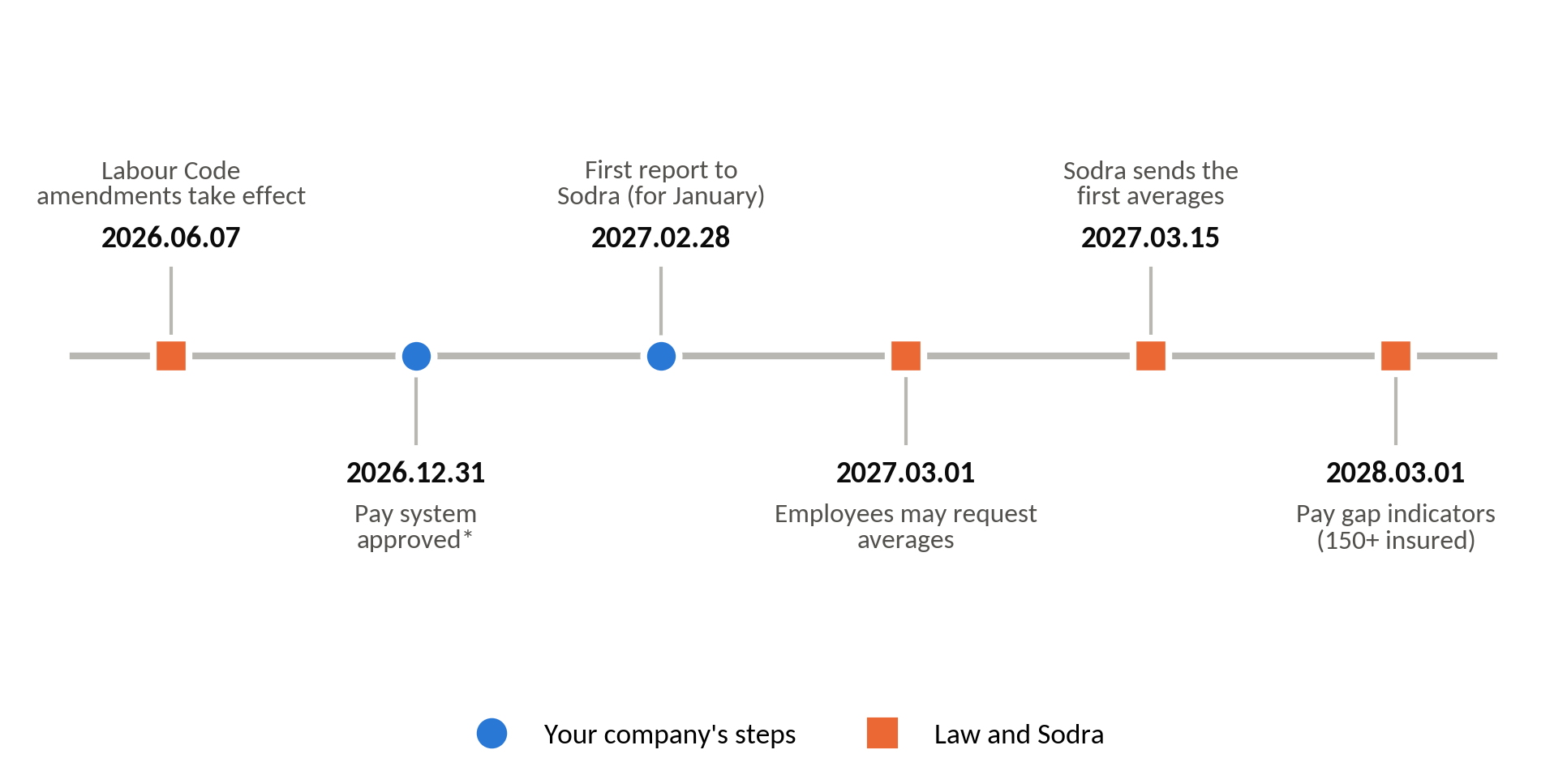
* Before approving the system, the employer must inform and consult the employee representatives. If the company has a works council, it must be informed at least 10 working days before the planned approval.
Deadlines and fines in one table
| What | By when | Fine or consequence | Source |
|---|---|---|---|
| Approve or review the pay system, after the informing and consultation procedures | 2026-12-31 | In our view, a missing system may be treated as a breach of the pay-setting rules: a fine of EUR 500–1450, EUR 1450–3000 for a repeat, EUR 2700–6000 if intentional. Another reading is a breach of labour laws: EUR 240–880 | Law amending the Labour Code, Article 23(4); DK Article 140(3); ANK Article 99(3)–(5), edition from 2027-01-01; ANK Article 96(2) |
| Inform the works council (20 or more employees) or an elected employee trustee (DK Article 177(2)) of the draft system; if there are none, the employer-level trade union | At least 10 working days before approval; our recommendation: at least 22 working days before the planned approval, so that consultation also fits | If the works council demands consultation and files a reasoned request, the system cannot be approved for up to 15 working days from the first day of consultation, unless another period is agreed | DK Article 206(1), (2) and (4); DK Article 204(4); DK Article 177(2) |
| First monthly SDUP report to Sodra for January 2027, then every month by the last day of the month | 2027-02-28 | Failing to give Sodra the information: a fine of EUR 460–700, EUR 700–1400 for a repeat | DK Article 23(3), edition from 2027-01-01; Order No. A1-433, point 2.1; ANK Article 99(1) and (2), edition from 2027-01-01 |
| Reply in writing to an employee request for pay data (requests from 2027-03-01) | Within 1 month of receiving the request; explanations no later than 2 months from receiving the original request | Failing to give an employee the information: a fine of EUR 460–700, EUR 700–1400 for a repeat | DK Article 148(5), edition from 2027-01-01; Order No. A1-433, point 2.3; ANK Article 99(1) and (2), edition from 2027-01-01 |
| Pay equally for the same work or work of equal value | Always | The employee is awarded compensation: unpaid pay, pecuniary and non-pecuniary damage, lost opportunities. Once the employee points to facts from which discrimination may be presumed, the employer must prove there was none | DK Article 219(2); DK Article 26(5) |
ANK Article 99 fines are imposed on employers or other responsible persons; the ANK Article 96(2) fine on employers who are natural persons, heads of legal-entity employers or other responsible persons. More in “Fines and disputes: the risk of having no pay system in Lithuania”.
Three thresholds: 10, 20 and 50 employees
Under 10 employees. The law provides no separate exemption. VDI says so plainly: by 31 December 2026 all employers must have these systems, regardless of size, type of work or sector (VDI FAQ, question 1.1). VDI also says that companies with fewer than 10 employees may need fewer criteria and fewer position groups (VDI FAQ, question 1.4). This is VDI guidance, not a statutory exemption.
Under 20 employees. A works council must be set up when the average headcount is 20 or more (DK Article 169(1)), except where more than 1/3 of employees are members of a trade union operating at employer level (DK Article 169(4)). In a smaller company employees may elect an employee trustee (DK Article 177(1)). If they do, the trustee has the works council’s rights (DK Article 177(2)).
Under 50 employees. Employers with fewer than 50 employees are exempt from setting pay increase criteria and procedure in the system (DK Article 140(3)). The exemption does not cover indexation: VDI says the duty to set indexation applies to all employers (VDI FAQ, question 1.7). VDI recommends setting the frequency, reference indicators, the formula, who decides, and the objective conditions under which indexation may be skipped (VDI FAQ, question 1.7).
What even the smallest system must contain
The law: under DK Article 140(3) the system must contain:
- Position groups, built on skills, qualification, effort, responsibility and working conditions.
- Pay amounts or ranges (minimum and maximum) for each group. VDI recommends stating gross, not net, amounts (VDI FAQ, question 1.8).
- Forms of pay: monthly salary or pay per hour.
- Grounds, amounts and procedure for allowances, supplements and bonuses.
- Indexation criteria and procedure, for example once a year by the inflation rate (CPI), with the conditions under which indexation may be skipped.
- Pay increase criteria and procedure, if you have 50 or more employees.
The employer approves the system and makes it available to all employees (DK Article 140(3)).
When the manager is the only employee. A system is still needed. If there are no other employees and none are planned soon, the system may be simplified: the pay terms for the manager are enough, based on objective, gender-neutral criteria (VDI FAQ, question 1.2).
Example: a 12-person trading company
The company has a manager, three sales managers, two customer service specialists, four warehouse workers, an accountant and an IT specialist. The positions were scored on the five DK criteria (how to do this: “Job evaluation and grouping for a pay system”). Job titles say nothing on their own, so the company scores its own real work.
| Group | Positions | Range around the group midpoint |
|---|---|---|
| I | Warehouse worker | 85–115 % |
| II | Customer service specialist, sales manager | 85–115 % |
| III | Accountant, IT specialist | 85–115 % |
| IV | Manager | 80–120 % |
The company sets each group’s midpoint from its current pay and market data. For example, the group III midpoint is [amount] gross per month, and the range runs from [amount] to [amount]. VDI recommends ranges of about ±15–20 % around the midpoint (VDI FAQ, question 1.9).
Look at group III. The accountant and the IT specialist scored about the same, so they share a group. If the market pays IT specialists more, that may justify placing the IT specialist higher within the range. But the reason must be written down and backed by data: the source, the date and the ranges in similar job ads.
Place within the range. Write three criteria into the system: experience in similar roles, competences and results. Record the reason for each employee’s place in the range in one sentence in their personnel file.
Bonuses. One rule for the whole company: who decides, for which indicators, what share of base pay, and when it is paid.
What cannot be simplified
- Every position belongs to a group, even if there is only one group.
- Every difference within a group has an objective, written reason. “It just happened” is not a reason. In our view, length of service counts only if the system lists it as a criterion for the place within the range.
- The system applies to everyone, not only to new hires (VDI FAQ, question 3.6).
If two people doing work of equal value are paid differently today for no reason, approving a system does not fix it. VDI says unjustified gaps should be fixed within a reasonable period, for example 6 months, usually by raising the pay of those who earn less (VDI FAQ, question 3.6).
Informing and consulting
Before the system is approved or changed, information and consultation procedures must be completed (DK Article 140(3)).
- 20 or more employees: the works council is informed ten working days before the planned approval (DK Article 206(2)). If the works council demands consultations within three working days, they start within the next three working days and last at least five working days, unless the employee representatives agree to a different period (DK Article 206(3) and (5)).
- 20 or more employees, but no works council: the employer must set one up (DK Article 169(1)), except where more than 1/3 of employees are members of a trade union operating at employer level (DK Article 169(4)). If a trade union operates at employer level, the information must go to it (DK Article 206(4)). Our recommendation: if there is no works council yet, set up the election commission now and prepare the system while the election runs. Consult the elected council. Consult all employees directly only if the election failed and you have the publicly announced protocol (DK Article 171(5) and (10)).
- Fewer than 20, but an employee trustee exists: in our view, treat the trustee as a works council (DK Article 177(2), Article 140(3)): inform 10 working days ahead and consult.
- No representatives at all: the law does not say how to consult. Our recommendation: give the draft to all employees in writing, allow at least 10 working days for comments, and record in a protocol which comments you accepted and why. VDI also recommends discussing the general grouping principles with employees (VDI FAQ, question 2.3). Steps, a notice and a protocol template are in “Pay system without a works council: how to consult employees in Lithuania”.
Consultation is not a vote. Employees comment, and you decide. But write down your answer to each comment: in a dispute it shows the system was not imposed from above.
Sample approval order
On the approval of the pay system
- I approve the pay system of UAB “[name]” (attached).
- The system applies to all employees from [date].
- I instruct [position] to make all employees familiar with the system by [date], by signature or by email, keeping the confirmations.
- The protocol of employee comments and the answers to them is kept with this order.
Manager [name, surname], [date]
Three more documents to fix at the same time
- Job ads. A job ad must state the offered base pay amount and/or range (DK Article 25(6)). In our view, the range should match the group in the system.
- Interviews. It is prohibited to require a candidate to disclose the pay received in current or previous jobs (DK Article 41(1)).
- Confidentiality clauses. Data on one’s own pay cannot be treated as confidential if the employee discloses it to enforce the right to equal pay (DK Article 39(1)).
Two more duties start in 2027. First, employees must be told every year about their right to receive pay data and how it is provided (DK Article 148(4), edition from 2027-01-01). Second, pay data must be filed with Sodra every month, and the first filing must give each employee’s position group number under the system. The first filing is due by 28 February 2027 for January 2027 (DK Article 23(3), edition from 2027-01-01; Order No. A1-433, point 2.1; Description points 6 and 7). So the group numbers must be clear in January. Employees may submit requests for data from 1 March 2027, at first only for monthly indicators (average pay per hour) (Order No. A1-433, point 2.3).
Work plan to 31 December 2026
| When | Task | Output |
|---|---|---|
| Start + 5 working days | List of positions, current pay, allowances and benefits | Completed table |
| Start + 10 working days | Update job descriptions and score the positions | Scoring sheet |
| Start + 15 working days | Draft system with groups and ranges | Draft |
| Start + 25 working days | Give the draft to employees and collect comments | Comments, protocol |
| Start + 30 working days | Approval by order | Approved system |
| Start + 37 working days | Employees made familiar; job ad and contract templates fixed | Signatures, updated templates |
If you have a works council, it must be informed at least ten working days before approval (DK Article 206(2)). Within three working days it may demand consultations, and they start within the next three working days (DK Article 206(3)). If the council makes a reasoned written request, you cannot approve the system for 15 working days from the first day of consultation, unless another period is agreed (DK Article 204(4)). So plan about 22 working days from informing the council to approval. If there is no works council yet, it must first be elected. From setting up the election commission to the council’s first meeting takes about 31–38 days (DK Articles 171(3) and (5), 173(1)). The earliest approval comes after about 7 weeks, or about 9–10 weeks with consultations. A company that starts late in the year may not manage to approve the system by 31 December 2026. So start at once. Our recommendation: if you start late, start the election and the system at once, record each step with its date, and approve the system as soon as the procedure allows. This does not change the 31 December 2026 deadline.
Mistakes worth checking
- Groups follow departments (“IT”, “sales”) rather than the value of the work.
- The range shows net pay.
- The system has ranges but no criteria for where an employee sits within them.
- Someone’s pay is already above the group maximum, with no explanation anywhere.
- The system is approved, but employees were not made familiar with it, and you cannot prove they were.
What to do if…
…the manager is the only employee, paid under an employment contract. A system is still needed (VDI FAQ, question 1.6). Write a one-page system: the manager’s position group, the pay amount or range, the criteria for setting it, and the bonus rules if any (VDI FAQ, question 1.2).
…your average headcount will reach 20 during the year. Works council elections must then be started (DK Article 169(1)), except where more than 1/3 of employees are members of a trade union operating at employer level (DK Article 169(4)), and changes to the system will have to be consulted with the council.
…your system was approved long ago. It must be reviewed and changed if needed by 31 December 2026 (Article 23(4) of the Law amending the Labour Code). Check that the groups follow the five criteria of DK Article 140 and that each group has a range.
…you will not make it by the end of the year. Our recommendation: do not wait. Approve the system as soon as you can and record when you started. The longer you have no system, the weaker your position in a possible dispute.
Frequently asked questions
Is a pay system required with fewer than 10 employees?
Yes. The law provides no separate exception, and VDI says that by 31 December 2026 all employers must have a system, whatever their size (VDI FAQ, question 1.1). Companies with fewer than 10 employees may need fewer criteria and fewer position groups (VDI FAQ, question 1.4).
Is a system needed if the manager is the only employee?
Yes, a system is needed even when the manager is the only employee, paid under an employment contract (VDI FAQ, question 1.6). If there are no other employees and none are planned soon, the pay terms of the manager, based on objective and gender-neutral criteria, are enough (VDI FAQ, question 1.2).
Does a company with fewer than 50 employees need pay rise criteria?
No. Employers with fewer than 50 employees are exempt from the duty to set criteria and a procedure for pay rises in the system (DK Article 140(3)). The exemption does not cover indexation (VDI FAQ, question 1.7).
How do we consult if there is no works council and no employee trustee?
If there is an employer-level trade union, the draft must be given to it (DK Article 206(4)). If there is none, the law does not say how to consult. Our recommendation: give the draft in writing to all employees, allow at least 10 working days for comments and record in a protocol which comments you took into account and why.
What if we cannot finish by 31 December 2026?
Our recommendation: do not wait. Approve the system as soon as you can and record when you started. The longer you have no system, the weaker your position in a possible dispute.
Related articles
- Job evaluation and grouping for a pay system: a practical guide
- Pay system without a works council: how to consult employees in Lithuania
- Job descriptions before job grouping: how to fix them in one week
- Hiring and job ads in Lithuania: pay ranges, interviews, confidentiality
- Pay system self-check: 20 questions for small and mid-size employers
- Pay transparency in Lithuania: what employers must do, and by when
How to start
Send us your list of positions, your employment contract template and any pay system you already have. We will help score the positions and prepare the system, the notice to employees, the protocol and the approval order.
Linden’s full solution, from the pay system to informing employees, is at atlygis.linden.lt. Check which requirements apply to you: atlygis.linden.lt/en/self-check.
Phone +370 5 212 1506, email info@linden.lt
More about this service: drafting labour law documents.


