
Fines and disputes: the risk of having no pay system in Lithuania
Updated 2026-10-22
A pay system must be approved or reviewed by 31 December 2026 (Article 23(4) of the Law amending the Labour Code). Without one, three things can follow: an administrative fine, an employee’s claim and, if you bid in public tenders, a risk of exclusion. In our view, for a small company the biggest risk is not the fine but a dispute with any departing employee. Once the employee points to facts from which discrimination may be presumed, the employer must prove there was none (DK Article 26(5)), and without a system there is nothing to rely on. What exactly must be done is set out in “Pay transparency in Lithuania: what employers must do, and by when”.
Implementation deadlines
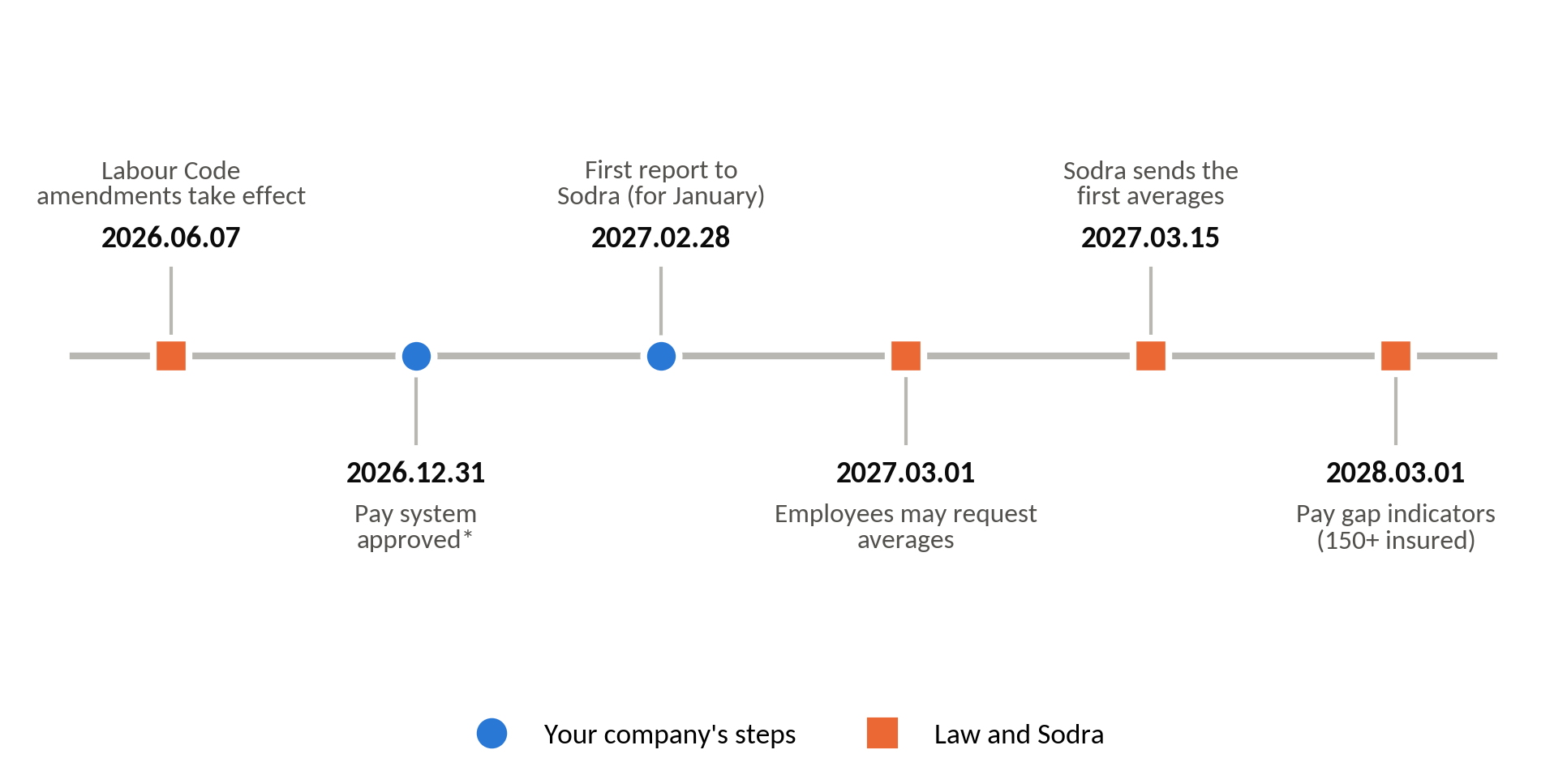
* Before approving the system, the employer must inform and consult the employee representatives. If the company has a works council, it must be informed at least 10 working days before the planned approval.
The risks in one table
| Risk | Who starts it | What follows |
|---|---|---|
| Administrative fine | VDI; from 2027, for failing to give information, also Sodra and the Equal Opportunities Ombudsperson | Fines under Article 99 of the ANK |
| Employee’s claim | A current or former employee | Unpaid pay, damages, compensation |
| Public procurement | The contracting authority | Possible exclusion from a tender |
Fines and deadlines in figures
| What | By when | Fine or consequence | Source |
|---|---|---|---|
| Approve or review the pay system, after the informing and consultation procedures | 2026-12-31 | In our view, a missing system may be treated as a breach of the pay-setting rules: a fine of EUR 500–1450, EUR 1450–3000 for a repeat, EUR 2700–6000 if intentional. Another reading is a breach of labour laws: EUR 240–880 | Law amending the Labour Code, Article 23(4); DK Article 140(3); ANK Article 99(3)–(5), edition from 2027-01-01; ANK Article 96(2) |
| First monthly SDUP report to Sodra for January 2027, then every month by the last day of the month | 2027-02-28 | Failing to give Sodra the information: a fine of EUR 460–700, EUR 700–1400 for a repeat | DK Article 23(3), edition from 2027-01-01; Order No. A1-433, point 2.1; ANK Article 99(1) and (2), edition from 2027-01-01 |
| Reply in writing to an employee request for pay data (requests from 2027-03-01) | Within 1 month of receiving the request; explanations no later than 2 months from receiving the original request | Failing to give an employee the information: a fine of EUR 460–700, EUR 700–1400 for a repeat | DK Article 148(5), edition from 2027-01-01; Order No. A1-433, point 2.3; ANK Article 99(1) and (2), edition from 2027-01-01 |
| Give the data to VDI or the Equal Opportunities Ombudsperson when they ask | Within the period they set, no later than 10 working days | Failing to give the information: a fine of EUR 460–700, EUR 700–1400 for a repeat | DK Article 148(6), edition from 2027-01-01; ANK Article 99(1) and (2), edition from 2027-01-01 |
| Correct an unjustified pay difference (employers with 100 or more insured persons) | Within 6 months of receiving the indicators; first indicators by 2028-03-01 (150 or more) or by 2031-03-01 (100–149) | If the average pay gap between women and men in any position group is at least 5 %, unjustified and not corrected within 6 months, a joint pay assessment with employee representatives is mandatory | DK Article 23(10) and (11), edition from 2027-01-01; Law amending the Labour Code, Article 23(5) |
| Pay equally for the same work or work of equal value | Always | The employee is awarded compensation: unpaid pay, pecuniary and non-pecuniary damage, lost opportunities. Once the employee points to facts from which discrimination may be presumed, the employer must prove there was none | DK Article 219(2); DK Article 26(5) |
| Employee’s claim to the labour disputes commission | Within 3 months of when the employee learned or should have learned of the breach; general limitation period 3 years | A missed deadline can be renewed if the commission finds the reasons important | DK Article 220(1) and (2); DK Article 15(2) |
| Risk of exclusion from a public tender after a breach of social and labour law obligations | While less than 1 year has passed since the breach | The contracting authority may exclude the supplier; it is not automatic and proportionality must be assessed | VPĮ Article 46(6), point 1; VPĮ Article 46(8) |
ANK Article 99 fines are imposed on employers or other responsible persons; the ANK Article 96(2) fine on employers who are natural persons, heads of legal-entity employers or other responsible persons.
| Offence | Fine | Repeat | Intentional | Source |
|---|---|---|---|---|
| Breach of the rules on setting, calculating and paying wages | EUR 500–1450 | EUR 1450–3000 | EUR 2700–6000 | ANK Article 99(1)–(3); from 2027-01-01 ANK Article 99(3)–(5) |
| Failing to give pay information required by the Labour Code to employees, their representatives, VDI, Sodra or the Equal Opportunities Ombudsperson (from 2027-01-01) | EUR 460–700 | EUR 700–1400 | – | ANK Article 99(1) and (2), edition from 2027-01-01 |
Administrative fines
The law: fines are set by Article 99 of the Code of Administrative Offences (ANK). Law No. XV-970 amended it: some changes apply from 7 June 2026 and others from 1 January 2027 (Article 5 of Law No. XV-970).
Now. A breach of the rules on setting, calculating and paying wages laid down in the pay system or the Labour Code carries a fine of five hundred to one thousand four hundred and fifty euros (ANK Article 99(1)). A repeat breach carries one thousand four hundred and fifty to three thousand euros (ANK Article 99(2)). An intentional breach: two thousand seven hundred to six thousand euros (ANK Article 99(3)).
From 1 January 2027 there is a new offence: failing to give pay information required by the Labour Code to employees, their representatives, VDI, Sodra or the Equal Opportunities Ombudsperson. It carries four hundred and sixty to seven hundred euros, and seven hundred to one thousand four hundred euros for a repeat (ANK Article 99(1) and (2), edition from 2027-01-01). The fines for breaching pay-setting rules stay the same and move to parts 3–5 (ANK Article 99(3)–(5), edition from 2027-01-01). VDI gives the same amounts (VDI FAQ, question 6.7).
Who investigates. VDI investigates Article 99 offences (ANK Article 589, point 58). From 1 January 2027 the Equal Opportunities Ombudsperson and Sodra may also investigate and draw up reports on failing to give information (ANK Article 99(1) and (2); ANK Article 589, points 3 and 72, edition from 2027-01-01).
Is there a fine just for having no system? Unless a collective agreement sets the pay system, the Labour Code requires the employer to approve a system (DK Article 140(3)). In our view, after 31 December 2026 a missing system may be treated as a breach of the pay-setting rules. Another reading is a breach of labour laws, which carries a fine of two hundred and forty to eight hundred and eighty euros (ANK Article 96(2)). We are not aware of published case law on how failing to approve a system after 31 December 2026 is classified, so it is our opinion, not settled law.
An employee’s claim: the employer must prove
Once an employee points to facts from which discrimination may be presumed, the employer must prove there was no discrimination (DK Article 26(5)). Such a fact may be that a colleague of the other sex doing the same work or work of equal value earns more. The employer must then prove the difference rests on objective, gender-neutral criteria. If there is no comparable employee of the other sex, the employee may rely on any other evidence, including statistics (DK Article 26(4), point 3). The comparison is not limited to employees hired at the same time (DK Article 26(4), point 4).
What can be awarded. If the employer breached the duty to pay equally, the employee is awarded compensation (DK Article 219(2)). It covers all unpaid pay or payments in kind, pecuniary and non-pecuniary damage, and compensation for lost work-related opportunities. In court cases on pay discrimination the court may depart from the usual rules on the allocation of legal costs (DK Article 217(4)).
Deadlines. A claim goes to the labour disputes commission within three months from when the employee learned or should have learned of the breach (DK Article 220(1)). A missed deadline can be renewed if the commission finds the reasons important (DK Article 220(2)). Even if it is not renewed, the employee may go to court within one month of the commission’s decision (DK Article 231(1)). The general limitation period is three years (DK Article 15(2)). In our view, a claim may cover up to three years, and from 2027 the day the employee “learned” may coincide with the day they receive their group’s data.
Why this matters for a small company. In our view, an employee who is dismissed or leaves on bad terms may also raise pay. If by the end of the year they received nothing about a pay system, it will be easy for them to say there is none. Without a system and scoring sheets it is very hard for the employer to prove a difference was justified.
A complaint to VDI
From 2027 an employee may ask in writing for their own pay data and the average pay by sex in their position group (DK Article 148(4), edition from 2027-01-01). The answer is due within one month (DK Article 148(5), edition from 2027-01-01). Employees may submit requests from 1 March 2027 (Order No. A1-433, point 2.3), and the employer provides the data once it receives them from Sodra. At first only monthly indicators (average pay per hour) are given (the first, in March 2027, for January); annual indicators follow from 1 March 2028 (Order No. A1-433, point 2.3). If the data are inaccurate or incomplete, the employee may demand additional explanations. Giving them may not take longer than 2 months from the day the employee’s request for the data was received (DK Article 148(5), edition from 2027-01-01). In VDI’s view, the 2 months run from the day the request for additional explanations was made (VDI FAQ, question 6.8). Our recommendation: plan for the earlier date, that is, under the statute, from the original request. If the explanations are not given, the employee may complain to VDI, and VDI may order the employer to provide the information and impose a fine (VDI FAQ, question 6.8). So a complaint is a route by which an inspection can reach a small company too.
VDI stresses that 5 % is not an allowed gap: any unjustified pay gap between men and women for the same work or work of equal value is a breach (VDI FAQ, question 7.1). Employers with 100 or more insured persons may in some cases also have to carry out a joint pay assessment (DK Article 23(11), edition from 2027-01-01). This 5 % and six-month rule applies from 2027, but in practice starts only once Sodra delivers the first indicators: by 1 March 2028 (150+ insured persons) or by 1 March 2031 (100–149) (the Law amending the Labour Code, Article 23(5)). Before 1 January 2027 the only such duty was for an employer with an average headcount of more than 20 to give, at least once a year at the request of the works council (or, if none, the trade union operating at employer level), anonymised data on average pay by position group and sex (excluding managerial staff, where the group has more than 2 employees) (DK Article 23(2)); that duty continues after 1 January 2027. From 1 January 2027, employers with 100 or more insured persons have two more duties. Within one month of receiving Sodra’s indicators, they must give employee representatives and employees the data on the gender pay gap by basic and supplementary pay (indicator 7). The data are given for position groups with more than 2 employees of either sex (DK Article 23(5), edition from 2027-01-01). If employees or their representatives ask, they must give explanations within one month of the request (DK Article 23(9), edition from 2027-01-01). Employers with fewer than 100 insured persons may tick a box in EDAS so that the same Sodra data-processing rules apply to their data (DK Article 23(4), edition from 2027-01-01; V-500 rules, point 7). Sodra then gives them their first indicators by 1 March 2031 (the Law amending the Labour Code, Article 23(5)). Our recommendation: do not opt in without legal advice.
Lessons from abroad. In the UK, nearly 1,900 warning notices were sent in 2023–2025 for failing to file gender pay gap reports, and not a single fine was imposed (regulator data obtained by the law firm Lewis Silkin, 2026-03-26). The bigger risk there is disputes. On 7 September 2026 the Employment Appeal Tribunal held in Next Retail Ltd v Thandi ([2026] EAT 130) that the retailer Next could pay warehouse staff higher basic pay than shop staff. The tribunal found that the aim of that pay included recruitment and retention needs for warehouse staff that did not exist in the shops. It rejected Next’s appeal on other differences, such as a lower night premium and unpaid breaks in the shops. This is not Lithuanian case law. In our view, the lesson applies here too: only a reason you can prove with documents defends a difference.
Public procurement risk
A contracting authority may exclude a supplier from a procurement procedure if it has breached the social and labour law obligations referred to in Article 17(2), point 2, of the Law on Public Procurement (VPĮ Article 46(6), point 1). Exclusion is possible if less than one year has passed since the breach. It is not automatic: the contracting authority decides, and it must prove the breach “by any appropriate means” (VPĮ Article 46(6), point 1). Before excluding, it must assess whether exclusion is proportionate to the supplier’s conduct (VPĮ Article 46(8)). In its ruling of 4 January 2024 in civil case No. e3K-3-65-381/2024, the Supreme Court of Lithuania held that proportionality must be assessed every time exclusion under Article 46(4) or (6) of the VPĮ is considered (para. 98). A formal, one-off minor breach with no significant bearing on the supplier’s reliability should not be treated as making exclusion proportionate (para. 101). Exclusion can be avoided by showing reliability: paying or undertaking to pay compensation for the harm and cooperating in the investigation (where applicable) and taking preventive measures, if the contracting authority accepts them as sufficient by a reasoned decision (VPĮ Article 46(10)). In the same ruling the court said a supplier can rely on this only in a later procurement, not in the one it has already been excluded from (para. 110). In our view, a VDI decision on a pay breach could be such evidence.
What to do now
- By 31 December 2026, after informing and consulting employees, approve the pay system and make all employees familiar with it, keeping the confirmations.
- Our recommendation: by 31 January 2027, write down an objective reason for every pay difference within a group. Where there is none, plan how to fix it.
- By 1 March 2027, prepare a reply template for employee requests and a request register.
- Always keep the scoring sheets, the consultation protocol and the reasons for pay decisions. In a dispute they are your main evidence.
What to do if…
…a departing employee says they were underpaid. Ask them in writing whom they compare themselves with and for which period. Collect the system for that period, the scoring sheet and the reason for their place in the range. Reply in writing, without admissions. A sample reply is in “An employee demands equal pay: what the employer should do”.
…VDI sends an enquiry. Provide the approved system, evidence of the consultation and the confirmations that employees were made familiar with it. If there is no system yet, say when you will approve it and start work at once.
…there is no system yet and an employee is already disputing pay. Do the scoring now and date it. It will not fix the past, but it will show whether a gap exists at all and help you decide about a settlement.
Frequently asked questions
What fine applies if there is no pay system?
In our view, after 31 December 2026 a missing system may be treated as a breach of the pay-setting rules: a fine of EUR 500 to 1450, EUR 1450 to 3000 for a repeat, and EUR 2700 to 6000 if intentional (ANK Article 99(3)–(5), edition from 2027-01-01). Another reading is a breach of labour laws, with a fine of EUR 240 to 880 (ANK Article 96(2)). We are not aware of published case law on this point.
What fine applies from 2027 for failing to give information?
Failing to give pay information required by the Labour Code to employees, their representatives, VDI, Sodra or the Equal Opportunities Ombudsperson carries a fine of EUR 460 to 700, and EUR 700 to 1400 for a repeat (ANK Article 99(1) and (2), edition from 2027-01-01).
Who investigates these offences?
VDI investigates Article 99 offences (ANK Article 589, point 58). From 1 January 2027 the Equal Opportunities Ombudsperson and Sodra may also investigate and draw up reports on failing to give information (ANK Article 589, points 3 and 72, edition from 2027-01-01).
Is a 5 % gap between men and women allowed?
No. VDI stresses that any unjustified pay gap between men and women for the same work or work of equal value is a breach (VDI FAQ, question 7.1). The 5 % threshold matters for when an employer with 100 or more insured persons must carry out a joint pay assessment (DK Article 23(11), edition from 2027-01-01), and for when employee representatives, VDI or the Equal Opportunities Ombudsperson inform the employee of the gap (DK Article 148(7), edition from 2027-01-01).
How long does an employee have to claim equal pay?
A claim goes to the labour disputes commission within three months from when the employee learned or should have learned of the breach (DK Article 220(1)). The general limitation period is three years (DK Article 15(2)). In our view, a claim may cover up to three years.
Can a breach cost us public tenders?
It can. A contracting authority may exclude a supplier that breached social and labour law obligations if less than one year has passed since the breach (VPĮ Article 46(6), point 1). Exclusion is not automatic: before excluding, the authority must assess proportionality (VPĮ Article 46(8)).
Related articles
- An employee demands equal pay: what the employer should do
- Employee requests for pay data from 1 March 2027: how to reply
- Pay system self-check: 20 questions for small and mid-size employers
- Labour Disputes Commission in Lithuania: how to file and by when
- Pay transparency in Lithuania: what employers must do, and by when
How to start
Send us your current pay system, your list of positions and, if a dispute has already started, the employee’s letter. We will assess the risk and prepare the system or the reply to the employee and to VDI.
Linden’s full solution, from the pay system to informing employees, is at atlygis.linden.lt. Check which requirements apply to you: atlygis.linden.lt/en/self-check.
Phone +370 5 212 1506, email info@linden.lt
More about this service: drafting labour law documents.


